
Shopping Cart




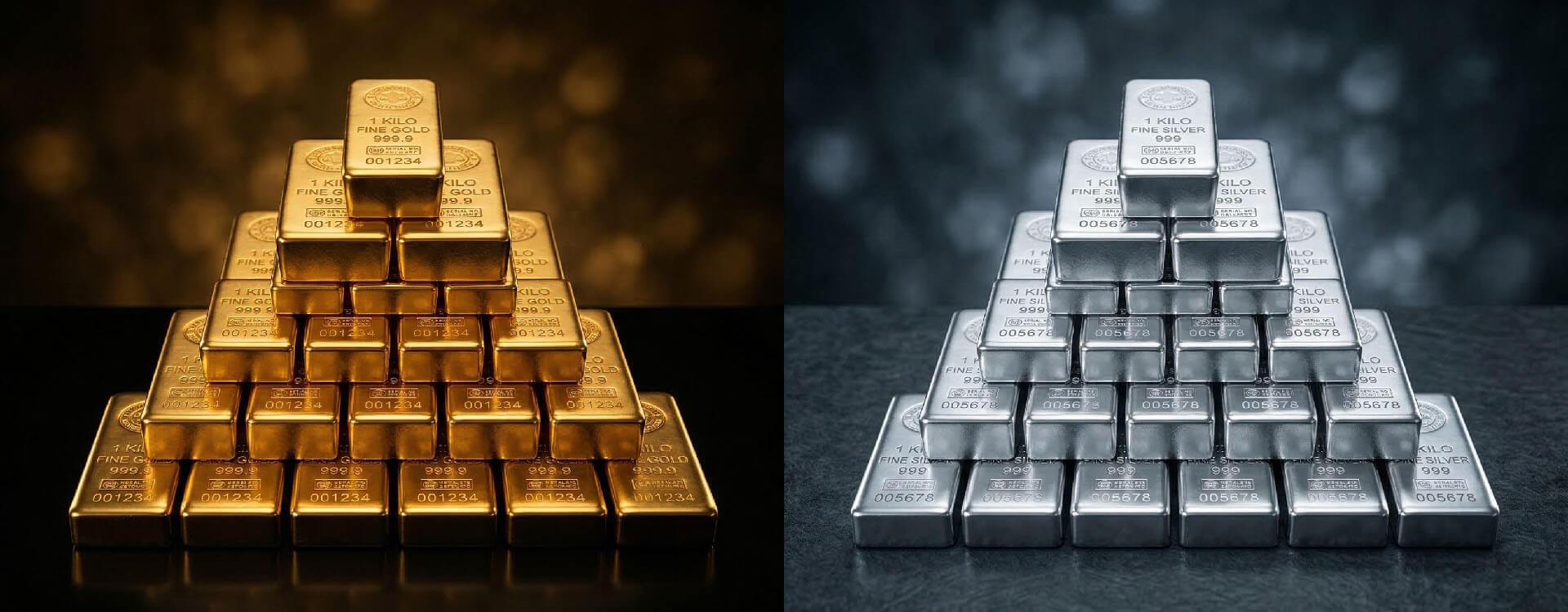
Gold and silver are the two pillars of precious metals investing, and understanding the relationship between them is essential for any serious precious metals investor. They share common characteristics — both are monetary metals with millennia of history as stores of value, both protect against inflation and currency debasement, and both tend to rise during periods of financial stress and dollar weakness. But they differ profoundly in their market dynamics, industrial applications, volatility profiles, and investment behaviour. At GoldMiner.cc, we don't ask investors to choose between gold and silver — we help them understand when and why to favour each, and how to use both strategically within a well-constructed precious metals portfolio.
The Gold-Silver Ratio: The Master Indicator for Precious Metals Investors
The gold-silver ratio — the number of ounces of silver needed to buy one ounce of gold — is one of the most important and historically rich indicators in precious metals markets. Over centuries, this ratio has averaged somewhere between 15:1 and 20:1 (reflecting the approximate natural abundance ratio of silver to gold in the earth's crust). In modern markets, the ratio has been far more variable, oscillating between approximately 30:1 and 120:1 over recent decades. When the ratio is extremely high — as it was at over 120:1 during the COVID-19 panic in March 2020 — silver is historically very cheap relative to gold, suggesting a strong case for favouring silver. When the ratio compresses to 40:1 or below, gold becomes relatively attractive. Monitoring this ratio allows investors to make strategic allocation decisions between gold and silver that can significantly enhance long-term returns.
Risk Profiles Compared: Gold's Stability vs Silver's Volatility
Gold and silver differ markedly in their volatility profiles. Gold is the more conservative of the two metals — its price movements are generally less extreme in either direction, making it the natural choice for the wealth-preservation core of a precious metals portfolio. Silver is substantially more volatile than gold, capable of dramatic moves in short time periods. In a strong precious metals bull market, this volatility is an investor's friend — silver characteristically outperforms gold significantly during the most powerful phases of a bull cycle. But in corrections and bear markets, silver also falls harder and faster than gold. This asymmetry — greater losses in downturns, greater gains in upturns — is why silver is sometimes described as "gold with leverage," and it is why position sizing and portfolio allocation must be managed more carefully with silver than with gold.
Industrial Demand: Silver's Unique Advantage
One of the most significant differences between gold and silver as investments is silver's substantial and growing industrial demand. Approximately 50–60% of annual silver consumption is industrial, encompassing applications in solar panels, electric vehicles, semiconductors, medical devices, water purification, and countless other technologies. This industrial demand component means that silver's price is influenced not only by financial and monetary factors — as gold's predominantly is — but also by the health of the global economy and the pace of technological adoption. For investors who are bullish on the green energy transition, the electrification of transport, and the growth of renewable energy infrastructure, silver offers a unique opportunity to participate in these trends through a precious metals investment framework. No equivalent industrial demand driver exists for gold.
Physical Ownership Considerations: Gold and Silver Compared
For investors considering physical precious metals ownership, the practical differences between gold and silver deserve careful attention. Gold's higher value density — currently thousands of dollars per ounce — means that a meaningful investment position can be stored in a relatively compact space. Silver, at a much lower price per ounce, requires substantially more physical volume to hold the same dollar value, which has significant implications for storage costs, insurance, and logistics. The silver price today or silver value today makes individual silver coins and small bars highly accessible to new investors with modest initial capital, which is one of silver's most appealing characteristics. Gold bars and gold coins, while representing larger per-unit investments, are easier to store and transport at scale. A comprehensive physical metals strategy at GoldMiner.cc considers both metals across multiple formats and storage solutions.
Building a Balanced Gold and Silver Portfolio
The most effective precious metals portfolios do not consist exclusively of either gold or silver — they combine both in proportions calibrated to the investor's objectives and current market dynamics. Gold provides the stable, crisis-resistant core; silver provides growth potential and industrial demand exposure. The optimal allocation between them shifts over the course of a precious metals market cycle: in early phases, when uncertainty is highest, gold typically leads and a higher gold weighting makes sense. As the cycle matures and investor appetite for risk grows, silver tends to accelerate and can be given a larger portfolio weight. As the cycle approaches its peak, trimming silver exposure and consolidating gains into gold provides a natural de-risking mechanism. This dynamic allocation approach — guided by the gold-silver ratio and macro indicators — is central to the precious metals strategy we implement and share transparently at GoldMiner.cc.